
CFER approach is based on the Prework training program, written by the Ministère de l'Éducation du Québec. In addition to the goals fixed in that program, CFERs use their own pedagogical tools and have a flexible work structure that allows our students to succeed.
As is the case with the Prework training program, students generally begin their training at a CFER at age 15. Due to academic difficulties, they have fallen significantly behind in their schooling; consequently, at age 15—with rare exceptions—they have not yet mastered the competencies expected by the end of primary school. Despite these challenges, thanks to adapted and stimulating educational tools, all young people at CFERs can experience success and make progress toward successful social and professional integration.
Our tools
Current events

Every day, CFER students learn about current events, which will serve as a basis for teaching.
To be an engaged citizen, the CFER student must understand the world surrounding him/her.
Citizen involvement

Throughout their CFER course, students will have to get involved in social or environmental projects. They will participate in "The Grande collecte CFER" a Spring cleanup project.
To be an engaged citizen, the CFER student has to get involved in his/her community.
Graduate's survival kit

Throughout their CFER course, students will prepare for socio-professional integration (resume, training and certifications, resource directory, etc.). Graduate's Survival kit is a virtual personnel space, the ultimate goal of the CFER pedagogy.
To be an autonomous person, the CFER student must build his adult life toolbox.
Caravans

CFER students are committed to promoting sustainable development by presenting the Caravans in various environments. These awareness-raising activities make it possible to engage in a civic approach, in addition to having a significant impact on self-esteem.
As an engaged citizen, the CFER student have an impact on today's issues.
Business

By developing their employability at school, CFER students enter the labor market better prepeared.
To be a productive worker, the CFER student enlarges his/her field of experience and expertise.
The global task
CFER teachers work as a global task. The global task is possible when a group of teachers jointly takes responsibility for the whole program of a group of students.
- Each member of the team represents an equal and equivalent part of a whole, the CFER. Everyone must therefore be able to express themselves freely.
- The absence of individualized schedules allows teachers to control, as much as possible, the variations of their environment. (Composition of groups, distribution of tasks/projects, timeline and opportunities, etc.).
- Teachers work as a team to provide better service to the students.
For more details on the global taskclick below:
The CFER Olympiads
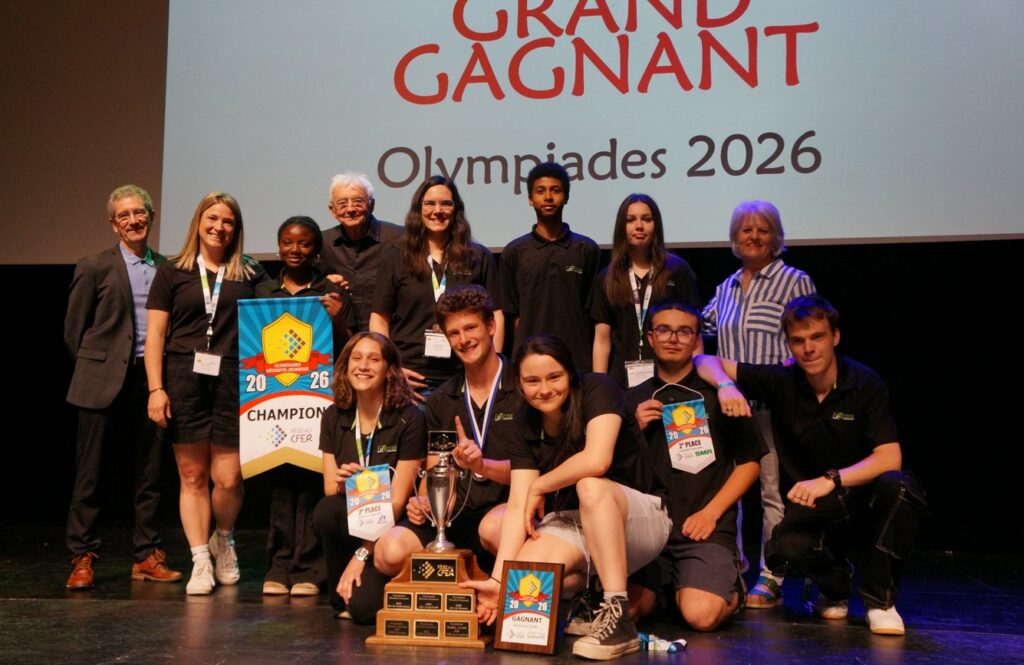
Every year, the Réseau CFER organizes the CFER Olympiads, a 3-day competition. 8 students from each of the 21 CFERs compete in challenges: Trivia, Manual Skills, Oral Expression and Sports. Which CFER will win the next Olympiads?
Trivia Presented by the Secrétariat à la jeunesse
Habiletés manuelles Presented by BMR
Expression orale Presented by Hydro-Québec
Activité sportive présentée par Sur le Chemin
Félicitations aux grands gagnants des Olympiades 2026!
2026: CFER des Navigateurs, Lévis
Gagnants des éditions précédentes:
2025: CFER Vallée-de-la-Gatineau, Maniwaki
2024: CFER des Navigateurs, Lévis
2023: CFER de Beauce, Sainte-Marie
Quel CFER remportera le trophée des Olympiades en 2027?
Partenaires
Les Olympiades CFER sont rendues possibles grâce aux partenariats d’affaires avec nos clients et grâce à l’appui d’organisations qui soutiennent la réussite éducative et le dépassement de nos élèves:
 English
  French